A network of premium autonomous settlements across the Mediterranean — where extraordinary lifestyle meets complete independence in energy, water, and food.
The world's critical systems — energy grids, water networks, supply chains, knowledge institutions — were never designed for the disruptions we now face. Climate volatility, geopolitical instability, infrastructure aging, and pandemic risk are not hypothetical futures. They are the present.
VEVA is a practical answer. Not survivalism. Not a commune. A small settlement that functions beautifully in normal times and survives gracefully without external support.
Premium architecture, Mediterranean climate, beach and mountain access, community, culture. VEVA residents don't downgrade their lives — they upgrade them while gaining security.
Solar arrays, battery banks, water systems, food production, medical capacity — all resident-owned, collectively operated, independently maintained. No landlord, no utility company, no fragile dependency.
Real estate in VEVA is not just property — it is a stake in a productive ecosystem. Land, systems, knowledge, and community that compound in value as the world around grows more uncertain.
Energy, water, food, medical capacity — the essentials must not depend on external grids that can fail.
No single point of failure. Every critical system has a backup path. Parallel, not series.
Where external supply chains work, use them. Where they are fragile, replace them. Pragmatic, not ideological.
Skills, methods, and institutional knowledge designed to survive and transmit across generations — not dependent on any single individual.
Systems designed to work with Mediterranean ecology — not against it. Water-wise. Climate-adapted. Regenerative where possible.
If a system partially fails, it degrades gracefully — not catastrophically. Residents retain dignity and essential function.
In any scenario — normal, crisis, or collapse — resident quality of life, social fabric, and personal agency are non-negotiable.
"The question isn't whether disruptions will come. The question is whether your family's life will change when they do."
This is not a whitepaper. The first village prototype is two years out. The team, the capital, and the experience are already in place.
Ukraine’s #1 EV charging infrastructure company. 25,000+ units manufactured, 4,000+ charge points deployed across 16 markets including Spain, Italy, and Cyprus. Their own factory in Odesa runs on solar + battery storage — energy-independent by design. In 2025, Ecofactor is building 52 highway Energy Hubs engineered to operate autonomously during grid outages — the exact "island mode" technology VEVA requires. They have tested energy resilience under real wartime grid collapse, not in a lab. Ecofactor Tech Ltd registered in Cyprus (December 2024) — the partnership is operational.
RYLEN brings development capital, real estate portfolio in Spain, and operational infrastructure across multiple asset classes. Backed by FRAM — a construction and engineering group founded in 2003 with its own manufacturing facility, international logistics fleet, and exports to 12+ countries including Spain, Italy, USA, and Canada. 50+ completed projects, 4 patents, full-cycle capability from engineering design through manufacturing to installation. The building envelope, facade systems, and structural execution for VEVA settlements are handled by people who have been doing this for over 20 years.
PhDs and research scientists in engineering, agriculture, and environmental systems. Team members from Stanford, Berkeley, and leading European institutions. The homework is done by people who wrote the textbooks.
Structural engineers, environmental psychologists, and architects who have designed for human communities — not just buildings. The settlement is designed for how people actually live.
The first VEVA village will be operational within two years. Not a rendering. Not a concept. A functioning settlement with real families, real energy independence, and real food production.
No tokens. No waitlists. No "community" that is actually a Telegram group. Concrete, steel, solar panels, water systems, and families who move in.
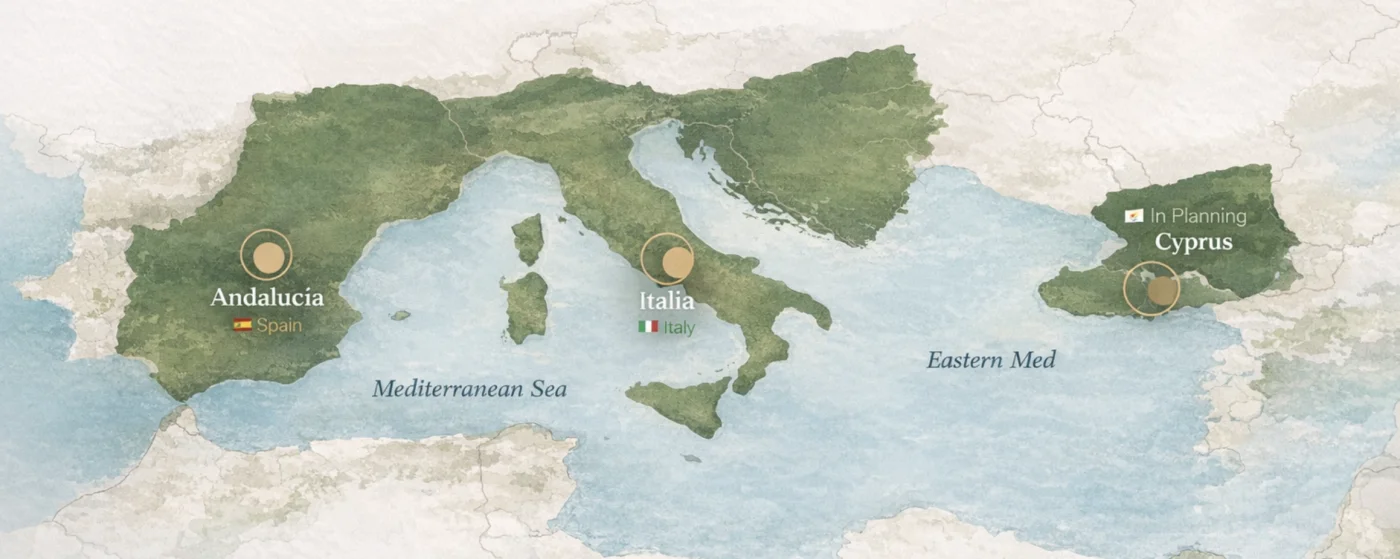
Three initial settlements across Spain, Cyprus, and Italy — each chosen for climate, land availability, legal environment, and strategic geography. Together they form a resilient network.
| Terrain | Coast + Sierra Nevada |
| Climate | 300+ sunny days/year, avg temp 18°C, 600mm annual rainfall |
| Solar | 1,450 kWh/kWp (fixed), 2,127 kWh/kWp (tracking) — IEA-PVPS |
| Water | Dual boreholes + rainwater harvesting + municipal backup |
| Energy | Solar PV 120–320 kWp + BESS 500 kWh–2 MWh + dual generators (2×60 to 2×125 kVA) |
| Food | 8–18 ha productive land, olive & citrus orchards, greenhouses |
| Special | Private airstrip capability, Atlantic & Mediterranean coast access |
| Legal | Andalusia LISTA 2021 — requires zoning and environmental due diligence |
| Size | 10–20 homes, 40–100 residents, 8–18 ha |
| Terrain | Coast + Troodos Mountains |
| Climate | 340+ sunny days/year, highest solar irradiance in EU |
| Solar | Highest solar yield in EU |
| Water | Desalination + wells + rainwater harvesting |
| Energy | Solar PV + BESS + micro-hydro potential from mountain streams |
| Food | Year-round growing season |
| Special | EU jurisdiction + Cyprus tax benefits, mountain & beach 40 min apart |
| Legal | EU / Cyprus — favorable tax residency framework |
| Size | 10–15 homes, 5–12 ha |
| Terrain | Coast + Hills |
| Climate | 280+ sunny days/year |
| Solar | Strong Mediterranean solar yield |
| Water | Natural springs + wells + stream-sourced micro-hydro |
| Energy | Solar PV + micro-hydro + BESS |
| Food | Rich agricultural tradition, world-class food culture |
| Special | Micro-hydro generation from mountain streams |
| Legal | EU / Italy |
| Size | 10–20 homes, 10–20 ha |
Mediterranean pipeline → Greece, Portugal, Montenegro. Global scouting → South America, Australia, New Zealand — targeting regions with rivers, strong solar, and abundant land. We are also actively seeking existing villages and rural settlements for partnership and management. Each new location joins the VEVA network — shared knowledge, shared systems, mutual support.
VEVA isn't about sacrifice. It's about having more.
Private or semi-private beach access at coastal or near-coastal sites. Paddleboarding, sailing, swimming — on demand, without crowds.
Hiking, mountain biking, and trail running at elevation. Mediterranean highlands offer seasons, wildlife, and solitude within minutes of the settlement.
A shared kitchen and dining space that blends communal cooking culture with premium food quality. Residents who want to eat together do. Those who want privacy have it.
Gym, sauna, cold plunge, yoga and movement studio. Designed for daily use, not occasional visits. Outdoor circuits and sport courts complement indoor facilities.
Fully equipped fabrication spaces — woodworking, metalworking, electronics, 3D printing. The tools to build, repair, and create anything the settlement needs.
Every household has dedicated growing space. Supplemented by shared orchards, greenhouse, and food forest. The pleasure of growing your own food alongside the security of it.
Settlement-wide EV charging powered by resident solar. Electric vehicles, electric bikes, electric everything — charged by the sun, not the grid.
Neighbours who know each other. Shared projects. Shared meals. Shared knowledge. The social fabric that modern suburban life systematically destroys — rebuilt by design.
Dedicated cleaning staff, cooks available on request, a small on-site agricultural team maintaining production year-round. Live-in service personnel with their own housing nearby. Use what you want, skip what you don’t — every service is opt-in, never imposed.
Multiple internet uplinks — Starlink, terrestrial fiber, LTE/5G backup, and local mesh. Never dependent on a single provider. Local AI and databases operate fully offline. You stay connected to the world, but you don’t need it to function.
Integrated health tracking infrastructure — air quality, water quality sensors, personal health data systems. Medical records on local servers. Telemedicine-ready. Preventive, not reactive.
Every number on this page comes from a published source.
| Category | Daily kWh | Source |
|---|---|---|
| Residential (50 units × 20 kWh) | 1,000 | IEA Residential Energy 2023 |
| Workshop & fabrication | 200 | Estimated from industrial benchmarks |
| Water pumping & treatment | 150 | WHO water energy intensity data |
| Cold storage & food systems | 100 | ASHRAE food storage benchmarks |
| Medical & comms infrastructure | 80 | WHO rural health facility standards |
| Lighting, EV charging, misc | 470 | Industry average EV + LED benchmarks |
| Total daily demand | 2,000 kWh/day |
| Parameter | Value | Source |
|---|---|---|
| Peak sun hours (annual avg) | 5.8 h/day | PVGIS EU Commission tool |
| Required PV capacity | ~500 kWp | Calculated: 2,000 / 5.8 / 0.7 derate |
| Land footprint (ground mount) | ~0.8–1.0 ha | NREL land use benchmarks |
| Panel type | Mono PERC or TOPCon | Current market standard |
| Estimated cost (installed) | €400–600k | EU solar contractor pricing 2024 |
| Parameter | Value | Source |
|---|---|---|
| Target autonomy (no sun) | 3 days | VEVA design spec |
| Required BESS capacity | 6,000 kWh usable | Calculated: 2,000 × 3 |
| Technology | LFP (lithium iron phosphate) | Safety + cycle-life optimum |
| Estimated cycle life | 4,000–6,000 cycles | CATL / BYD published specs |
| Estimated cost | €1.2–1.8M | Current LFP pricing ~€200–300/kWh installed |
| Parameter | Value | Source |
|---|---|---|
| Fuel type | Biodiesel / HVO / dual-fuel | VEVA preference for locally producible fuel |
| Capacity | 200–400 kW | Peak demand coverage |
| Runtime target | 30 days at 50% load | VEVA design spec |
| Fuel storage | 20,000–30,000 L | Calculated from consumption rate |
Solar PV — the main supply. Sized for worst-month generation sufficiency.
LFP battery bank — 3-day autonomy without sun or generator.
Biogas from settlement waste — continuous low-level generation, heat recovery.
Diesel/biodiesel generator — 30-day fuel reserve. Last resort, not daily use.
Hand tools, gravity water systems, non-electric processes for critical functions.
Water is the single biggest risk for autonomous settlements in the Mediterranean. We treat it accordingly.
| Use Category | Litres/Person/Day | Total (200 persons) | Source |
|---|---|---|---|
| Drinking & cooking | 5 | 1,000 L/day | WHO minimum 20 L/person/day potable |
| Sanitation & hygiene | 50 | 10,000 L/day | WHO adequate standard |
| Irrigation (food production) | 100 | 20,000 L/day | FAO Mediterranean crop water needs |
| Livestock & animals | 20 | 4,000 L/day | FAO livestock water use estimates |
| Fire reserve (annualised) | 5 | 1,000 L/day equiv | EU rural fire safety standards |
| Total daily demand | 180 | ~36,000 L/day |
Primary supply at most sites. Mediterranean aquifers are generally accessible at 40–120m depth. Professional hydrogeological survey required before site commitment. Yield target: 10–20 m³/hour minimum.
Roof and ground catchment systems. Mediterranean rainfall is seasonal but substantial — 400–700mm/year across most target regions. Large cisterns (500–2,000 m³) capture winter rains for summer use.
Where available, springs provide gravity-fed supply requiring minimal energy. Subject to seasonal variation and must be treated. Not reliable as primary source but excellent as supplementary.
Reverse osmosis as emergency or supplementary source, particularly for Cyprus sites with sea access. High energy cost (~3–5 kWh/m³) — requires dedicated solar allocation. Not primary, but available.
| Minimum operational reserve | 30 days |
| Drinking water reserve (separate) | 90 days in sealed tanks |
| Fire suppression reserve | 100 m³ dedicated |
| Grey water recycling | 60–80% of sanitation water recirculated to irrigation |
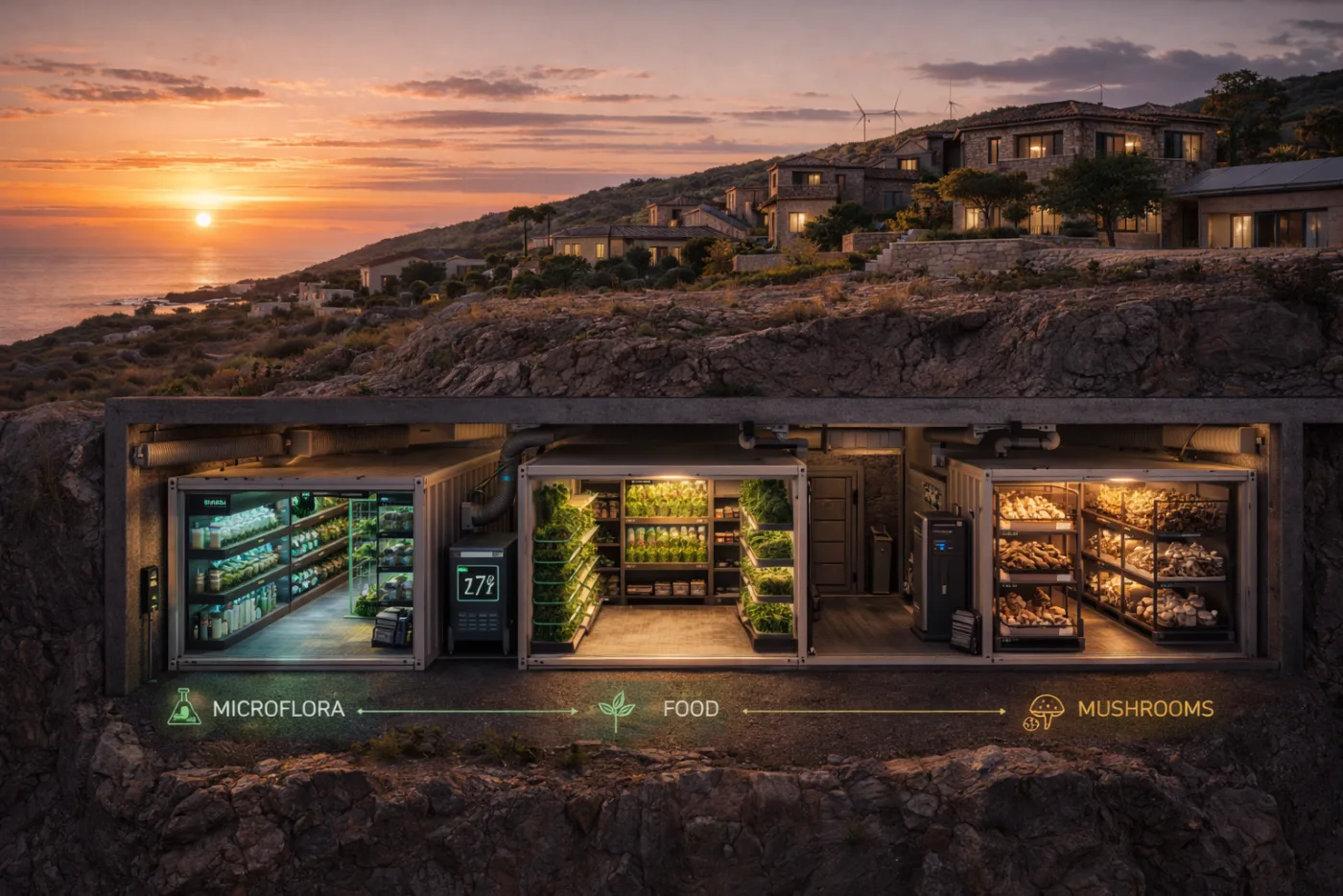
Multi-story farms, closed-cycle animal systems, vertical growing, and 5–10 year food reserves. Not partial coverage — a path to full autonomy.
We are not designing for 40–60% caloric coverage. We are engineering for 5–10 year autonomous food supply with a development path to full independence. Multi-story vertical farms, closed-cycle animal husbandry with internal micro-ecology (no smell, no waste leakage), and advanced poultry systems designed by specialist partners who have spent years researching exactly this. The settlement includes eco-structuring capabilities — working with animals, composting, biogas, and soil regeneration as one integrated cycle. Our team includes companies with proprietary know-how in high-efficiency indoor farming, animal welfare systems, and closed-loop bioproduction. This isn’t theoretical — the research exists, the partners are on board, and the goal is to build something genuinely extraordinary.
| Production Type | Area Required | Output | Source |
|---|---|---|---|
| Market garden (intensive) | 1–2 ha | Vegetables year-round | Eliot Coleman intensive methods |
| Orchard (olive, citrus, fig) | 5–8 ha | Oils, fruit, preserves | FAO Mediterranean orchard data |
| Food forest (multi-layer) | 3–5 ha | Nuts, fruit, perennials | Agroforestry Research Trust |
| Annual grain/legume | 4–6 ha | Partial grain supply | FAO yield tables |
| Greenhouse (year-round) | 0.5–1 ha | Seedlings, off-season crops | Commercial greenhouse benchmarks |
Adjacent to dwellings. High-intensity, daily-use vegetables and herbs. Managed by each household.
Shared intensive production. Managed collectively. Supplies common kitchen and supplements household needs.
Long-term productive landscape. Requires years to reach full production — must be planted at founding.
Annual grain, legume, fodder crops. Integrated with livestock grazing where appropriate.
| Poultry | Chickens for eggs and meat. Low land requirement. High protein yield per m². |
| Aquaculture | Small-scale fish pond or tank system. Tilapia, carp, or Mediterranean species. |
| Insects | Black soldier fly larvae for feed conversion. Minimal space, high protein, processes organic waste. |
| Legumes | Lentils, chickpeas, beans — Mediterranean staples, drought-tolerant, nitrogen-fixing. |
| Dairy / Goat | Small goat herd for dairy. Browsers well-suited to Mediterranean terrain. |
Open-pollinated seed library maintained on-site. Mediterranean-adapted varieties. Replicated in at least two locations (on-site + network partner settlement). Detailed seed-saving protocols maintained in the knowledge archive.
A settlement that produces waste it can't process is a settlement with a ticking clock.
All organic waste — kitchen scraps, garden material, crop residue — composted on-site. Target: zero organic matter leaving the settlement. Compost returns fertility to growing zones. Vermicomposting for high-value amendment. Hot composting protocols for pathogen kill.
Anaerobic digester processes food waste, animal manure, and selected organic streams into biogas (cooking fuel) and liquid digestate (fertiliser). A 10 m³ digester serves 20–30 households. Net result: waste becomes fuel and fertility.
No chemical pesticides in the settlement food zone. Biological controls: beneficial insects, companion planting, physical barriers. Chickens as mobile pest control units. IPM protocols documented and maintained by Food Guild.
Minimisation at source — purchasing protocols that favour repairable, recyclable, returnable. On-site separation and storage. Regular collection by regional recycling services. Repair culture: workshops exist to fix before discard.
Constructed wetland or reed bed system for tertiary treatment. Grey water (shower, sink) recycled to sub-surface irrigation after simple filtration. Black water processed through biodigester or composting toilet system — output safe for orchard application after adequate processing time.
Health infrastructure that doesn't depend on a 15-minute ambulance response.
Every adult resident trained in first aid, CPR, and basic trauma response. Annual refreshers mandatory. A minimum of 4 residents trained to Wilderness First Responder (WFR) level or equivalent. Managed by the Capability School.
Dedicated medical room with surgical lighting, examination table, oxygen, AED, IV fluids, and a maintained formulary. Stocked for 90-day self-sufficiency for common conditions. Dental capability (extraction, basic procedures).
At least one resident physician or nurse practitioner strongly preferred — supported by housing and infrastructure contribution offset. Telemedicine integration for specialist consultation. Network-level medical expertise pooling across VEVA settlements.
Established protocols for rapid evacuation to nearest hospital (30–90 min by road). Private airstrip capability at larger sites for medevac. Network mutual-aid protocol — any VEVA settlement can provide emergency shelter and care for residents of another.
Dedicated isolation dwelling(s) with separate ventilation and entry. Design requirement, not retrofit.
UV + filtration + chlorination for all potable water. Monitored continuously.
No untreated human waste in soil system. Composting toilets or biodigester with pathogen kill step.
Integrated pest management. No standing water near dwellings. Natural mosquito control (bats, dragonfly habitat) supplemented by targeted intervention.
Dedicated food prep and storage protocols. Cold chain maintained by priority power allocation.
The settlement that survives 200 years preserves the method of thinking, not just the answers.
Solar, batteries, water systems, construction, electronics repair, agricultural science, medical capability. The hard skills that keep the settlement running.
Permaculture, seed saving, animal husbandry, fermentation, natural building, ecosystem management. The skills of living with the land rather than against it.
Critical thinking, conflict resolution, governance, record-keeping, teaching methodology, decision-making under uncertainty. The social technology of a functioning community.
Complete offline Wikipedia, medical references, engineering manuals, seed databases — stored on local servers with no internet dependency.
Critical procedures in waterproof, durable print. Power-independent access. Stored in climate-controlled archive room.
Recorded demonstrations of all key skills. Indexed and searchable on local server.
Formal mentorship program ensuring experiential knowledge is transmitted person-to-person, not only text-to-person.
A mission-specific intelligence layer for the settlement.
Real-time monitoring and optimisation of solar generation, BESS state, load balancing, and generator scheduling.
Aquifer levels, cistern capacity, consumption tracking, quality sensing, irrigation scheduling.
Harvest logs, seed inventory, cold store monitoring, nutritional gap analysis, planting calendar optimisation.
Symptom assessment, drug interaction checking, procedure guidance, telemedicine routing — offline-capable LLM.
Perimeter sensing, anomaly detection, access logging — privacy-respecting, resident-controlled.
Local RAG system over the full settlement knowledge archive. Ask any question, get a sourced answer.
What-if simulations for resource planning, seasonal forecasting, emergency response pre-positioning.
Server infrastructure cooled using passive thermal design + earth-coupled cooling where possible. In Mediterranean climate, significant free cooling available 8 months/year. Waste heat routed to water heating system — efficiency gain, not just a cost.
All critical AI functions run locally, no internet dependency.
Full large language model capability on local hardware — medical, technical, agricultural consultation.
Dual server stacks with hot failover. Battery-backed UPS for graceful shutdown.
All resident data stays on settlement servers. No cloud sync of sensitive information.
No proprietary dependencies that can be remotely disabled or monetised against residents.
Starlink + terrestrial fiber + LTE/5G + local mesh network. No single point of connectivity failure. Satellite backup always available.
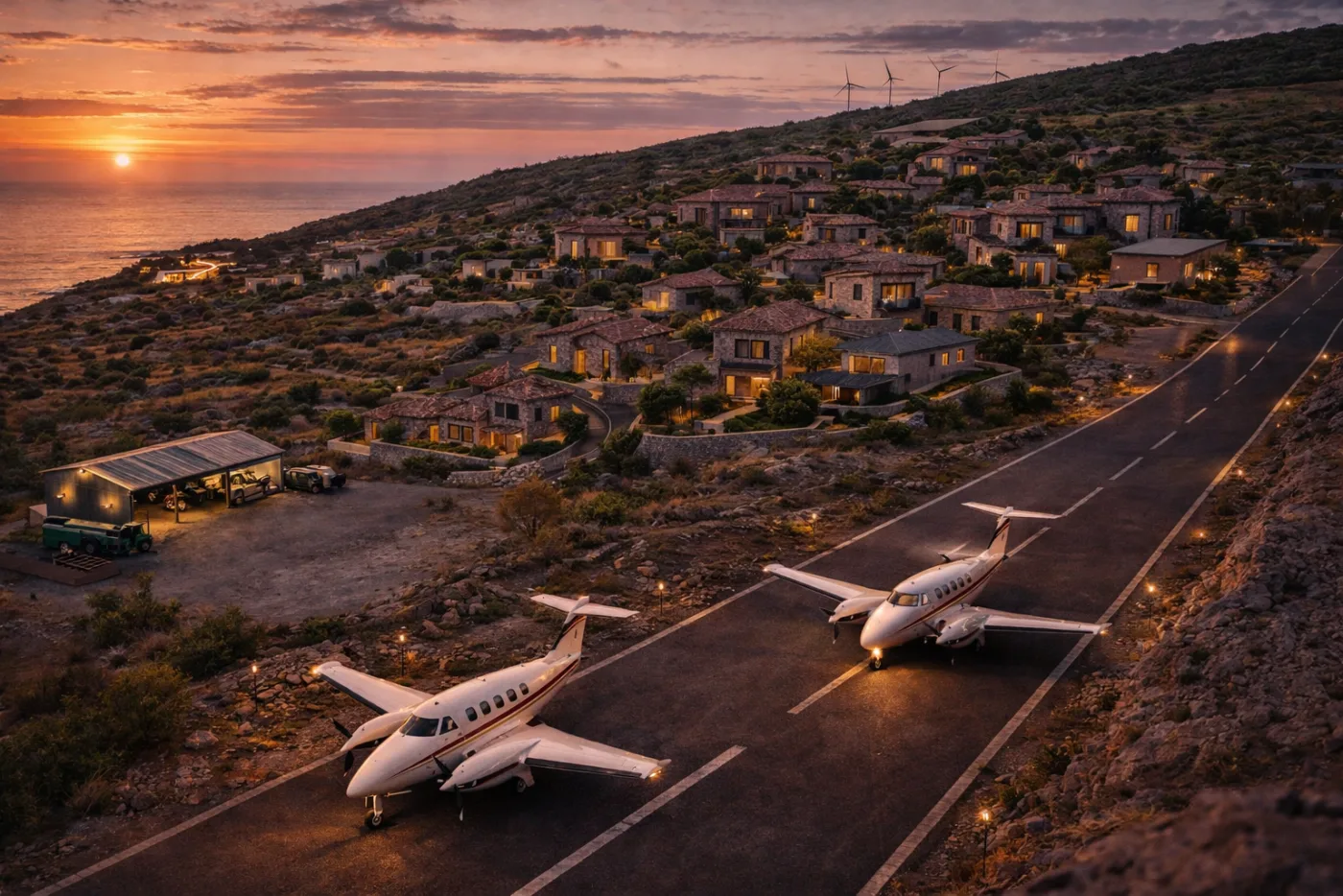
Private airstrip capability for medevac and logistics.
| Minimum length | 600 m (ultralight / small aircraft) |
| Target length | 800–1,000 m (light twin, turboprop, air ambulance) |
| Surface | Compacted gravel or paved — site-dependent |
| Width | 18–23 m standard |
| Night lighting | Solar-powered runway edge lights — grid-independent |
| Wind sock & markings | Standard ICAO visual aids |
Approach and departure paths clear of obstacles per relevant aviation authority standards.
Private airstrip registration required in all target countries. Straightforward process in Spain, Cyprus, Italy with proper planning.
Runway doubles as emergency vehicle access route and solar array strip when not in active aviation use.
Registered drone operations for perimeter monitoring, delivery, and survey. Airstrip provides legal operating base.
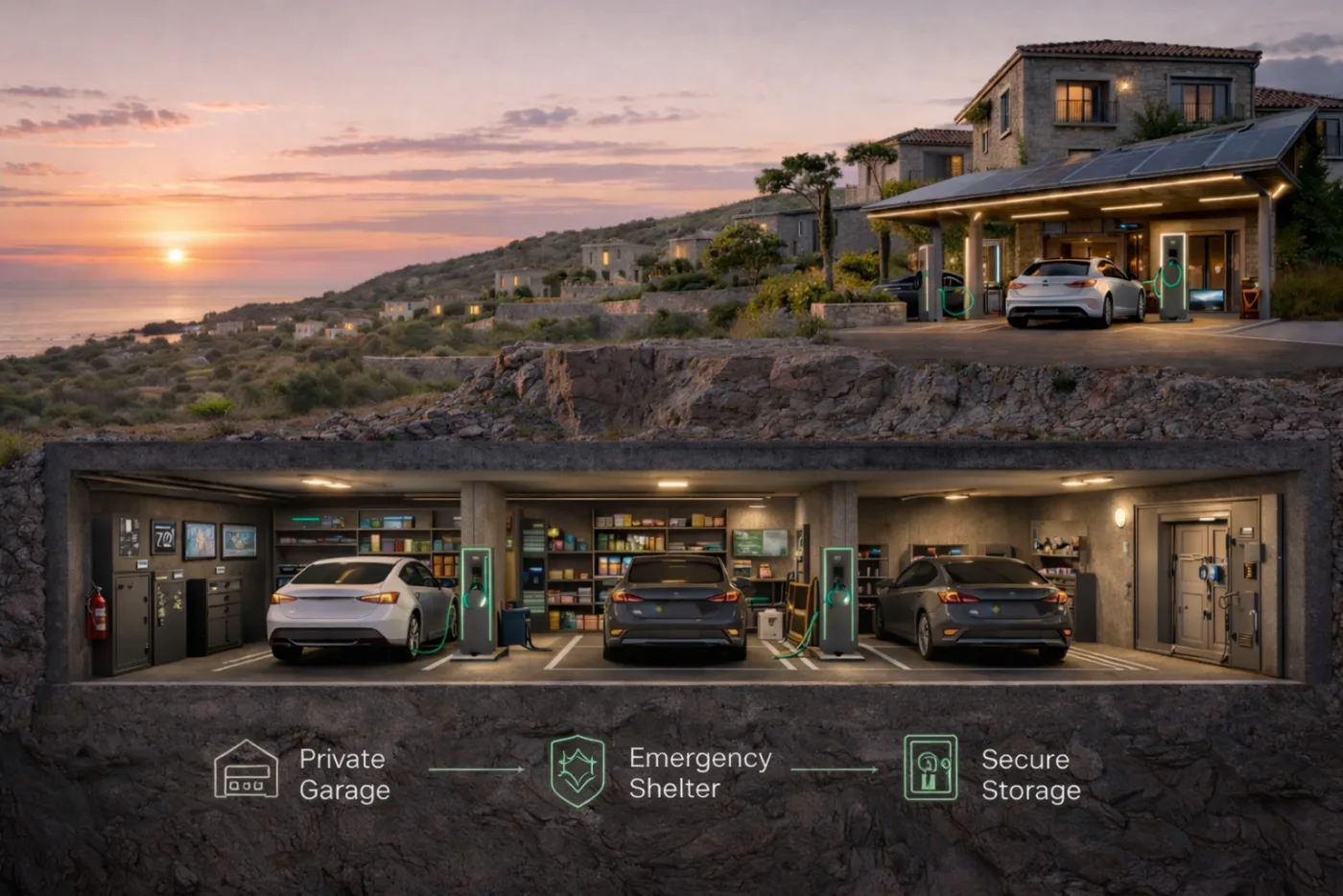
Everything important lives underground.
Underground reinforced concrete cisterns for rainwater and treated water storage. Gravity-fed to distribution where terrain allows. Passive cooling maintains water quality.
Underground fuel tanks (diesel, biodiesel, HVO). Fire-safe, temperature-stable, compliant with local regulations. 20,000–30,000 L capacity.
LFP battery bank in partially underground, ventilated vault. Temperature management critical for cycle life — earth-coupled cooling reduces HVAC load.
Climate-controlled underground room for physical knowledge archive, printed manuals, seed bank, and critical documents.
All critical infrastructure runs (power, water, comms, data) in underground conduits. Protected from surface events, UV, and physical damage.
Traditional passive cooling for food storage. Earth-covered structures maintaining 10–15°C year-round in Mediterranean climate. Zero energy cost.
Some residents will want their own underground or semi-underground spaces — workshops, studios, wine cellars, or personal retreats. The settlement design accommodates this where geology allows. A man's cave is his own. Properly waterproofed and ventilated, underground residential spaces in Mediterranean climate are comfortable year-round with minimal energy input.
Mediterranean winters bring significant rainfall. All underground structures require professional waterproofing design. This is not a DIY domain.
Italy and Cyprus are seismically active. All subsurface construction to local seismic code as minimum — VEVA target exceeds code minimum.
Some Mediterranean geology produces radon. Site-specific testing required. Ventilation design addresses this where present.
All subsurface infrastructure sized for human access and maintenance. No sealed voids. Annual inspection protocol.
Not if. When. Here's the difference VEVA makes.
Refrigerated food spoils within days. No heating or cooling. Medical devices fail. Economic activity halts. Depending on season and location, this ranges from 'very inconvenient' to 'life-threatening'.
VEVA continues on solar + BESS. Full refrigeration, lighting, communications. Medical systems unaffected. No lifestyle disruption for up to 3 days; generator supplements for extended outage.
Supermarket shelves empty within 3–7 days of a serious disruption. Most urban households have 3–7 days of food. 6 months of disruption would be catastrophic for most families.
VEVA has 6-month dry goods reserve plus active food production. Residents experience 'reduced menu variety', not hunger. Supply disruption is a planning event, not an emergency.
Taps run dry. Bulk water deliveries begin — expensive, limited, politically allocated. Sanitation systems fail. Disease risk rises sharply.
VEVA draws from borehole and cistern reserve. 30-day reserve minimum, 90-day drinking water reserve. Water recycling reduces ongoing demand. Desalination available as last resort.
Households isolated in apartments. Supply chains disrupted. Medical system overwhelmed. No community support. Mental health crisis compounds physical risk.
VEVA has designated quarantine facilities. Medical capability on-site. Food and water secured. Community operates at reduced but functional level. Residents support each other with space to do so.
Bank accounts frozen or restricted. Currency devalued. Physical assets vulnerable. Flight impossible or unaffordable.
VEVA residents have real asset backing — land, infrastructure, productive capacity — that doesn't freeze. Settlement is self-sufficient regardless of financial system state. Network provides geographic diversification.
Roads deteriorate. Municipal water becomes unreliable. Power cuts become frequent. Government services contract. 'Normal' slowly stops being normal.
VEVA infrastructure is maintained by residents with full ownership and incentive. No dependence on municipal services that may degrade. The settlement improves over time as residents invest in it.
Governance that enables life, not bureaucracy that consumes it.
Decisions made at the lowest effective level. Household decisions stay household decisions. Settlement decisions require collective input only when they genuinely affect the collective.
All financial accounts, infrastructure status, and governance decisions openly accessible to residents. No hidden decisions. No black boxes.
Governance authority proportional to contribution and stake. Those who bear consequences have voice. Those who bear no consequence have no override.
Core governance principles changeable only with 75%+ resident agreement. Protects against capture by any faction.
Elected 5–7 person body for strategic decisions, infrastructure investment, admission of new residents.
Professional role — maintains energy, water, and digital systems. Accountable to Council.
Resident committee managing food production zones, seed bank, and harvest allocation.
Resident physician or nurse role — manages medical facility, health protocols, and emergency response.
Manages the knowledge archive, Capability School curriculum, and skill assessment.
Manages access protocols, monitoring systems, and emergency response coordination.
A settlement of 50 units (100–200 people) is large enough to have genuine social diversity and role specialisation, but small enough for everyone to know everyone. This is the optimal scale for community resilience — above Dunbar’s number for intimate relationships but well within the range for functional trust networks. Governance is light because social accountability is high.
Every claim backed by published research.
Our microgrid architecture is based on NREL’s finding that hybrid systems (PV + battery + generator) consistently outperform single-source designs in both reliability and lifecycle cost. This is why VEVA uses a 5-layer energy stack, not just solar.
www.nrel.gov ↗Validates our cluster approach: 10–20 homes sharing distributed energy resources is the optimal scale for microgrid resilience. Directly informs VEVA settlement sizing.
www.nrel.gov ↗Source for our EV energy math: 36.7 kWh/100 miles (≈22.8 kWh/100 km). Used to calculate per-home EV charging demand and size the smart charging pool.
www.epa.gov ↗Our solar yield calculations: 1,350–1,450 kWh/kWp/year (fixed-mount) and up to 2,127 kWh/kWp (tracking) for Spanish sites. Basis for all PV array sizing.
iea-pvps.org ↗Critical distinction between power capacity (kW) and energy capacity (kWh) for battery sizing. Informs our BESS specification: 500 kWh–2 MWh usable with 2–3 day autonomy target.
www.nrel.gov ↗Official Spanish domestic water consumption: 128 L/person/day. Our target of 90–120 L/person/day is set against this benchmark — economical but not ascetic.
www.ine.es ↗Spain’s national water stress data, irrigation demand patterns, and seasonal variation. Critical for sizing water storage and understanding peak summer agricultural demand (3–5× domestic use).
www.miteco.gob.es ↗Legal framework for greywater reuse in Spain under Royal Decree 1620/2007 and 2023 updates. Determines what VEVA can legally do with treated wastewater for irrigation.
www.garrigues.com ↗Peer-reviewed confirmation that decentralized water/wastewater systems significantly strengthen settlement resilience vs. centralized municipal dependency. Validates our multi-source approach.
www.nature.com ↗Quantifies how animal-heavy diets dramatically increase land requirements. Basis for VEVA’s plant-forward + eggs + poultry strategy as the land-optimal protein mix.
www.mdpi.com ↗WHO directly links WASH to disease prevention. Sanitation failure is the #1 historical cause of settlement collapse. This drives our insistence on professional wastewater treatment, not DIY septic.
www.who.int ↗All antibiotic use in VEVA follows WHO protocols with diagnostic criteria. Improper use drives resistance — a critical risk for any community with limited pharmaceutical resupply.
www.who.int ↗Framework for our essential medicines stockpile. The WHO Model List defines the minimum needed for a basic healthcare system — our pharmacy follows this structure with 90-day reserves.
www.who.int ↗FAO promotes community seed banks as tools for resilience and preservation of locally adapted varieties. VEVA’s seed bank follows this model with annual viability testing and cross-settlement duplication.
www.fao.org ↗Post-harvest losses from weak cold chains destroy a significant share of production. This is why VEVA cold rooms are priority loads on the energy system — always powered, never shed.
www.fao.org ↗Passive House envelope cuts heating/cooling demand by ~80%. Every VEVA home targets this standard — the single biggest leverage point for energy autonomy.
passivehouse.com ↗Comprehensive microgrid design guide. Used for our island-mode architecture, load shedding priorities, and generator integration strategy.
www.nrel.gov ↗Chip-level liquid cooling with zero evaporative water use, saving 125M+ liters/yr per facility. VEVA’s AI core uses closed-loop cooling with heat recovery to greenhouses and hot water.
news.microsoft.com ↗Spain’s AESA regulates restricted-use aerodromes. Straightforward authorization process for ICAO Code 1 (<800m runway) private strips with proper planning.
www.seguridadaerea.gob.es ↗Spain solar PV: 32 GW installed capacity, 17% of total generation. Confirms Mediterranean Spain as one of Europe’s strongest solar environments for our settlements.
www.ree.es ↗Framework for our 200-year knowledge hierarchy. Dartnell’s work on post-catastrophe knowledge rebuilding directly influenced our 4-layer model: Don’t Die → Keep Producing → Keep Society → Keep Science.
the-knowledge.org ↗CDC specifically warns about botulism from improper home canning. All VEVA food preservation follows strict protocols with batch logging, temperature verification, and trained operators.
www.cdc.gov ↗Benchmark: ~187 eggs/hen/year. Used to size our flock: 40–80 hens for 40 people, 100–180 for 100 people, with ongoing feed supply from settlement waste + legumes.
extension.missouri.edu ↗Comprehensive 2025 review of community microgrid design. Validates our multi-layer approach and confirms PV + BESS + generator as the resilience-optimal configuration.
www.mdpi.com ↗ASHRAE and UK government confirm industry shift toward closed-loop and zero-water cooling designs. Supports our zero-water AI core cooling specification.
www.gov.uk ↗ICAO Code 1: <800m runway for ultralight/STOL. Code 2: 800–1,200m for small single-engine. Our 600–800m airstrip targets Code 1 with STOL medevac capability.
skybrary.aero ↗You want to live in VEVA. You are buying a home and a stake in the infrastructure. You commit to participating in the settlement community — not just owning a house.
Enquire as ResidentYou want exposure to VEVA as an investment — land, infrastructure, or the operating entity. You believe in the model and want financial participation without necessarily relocating.
Discuss InvestmentYou have skills we need — hydrology, agronomy, solar engineering, medicine, architecture, governance design. You want to help build this and potentially earn a place in it.
Offer ExpertisePrefer email? Write directly:
[email protected]